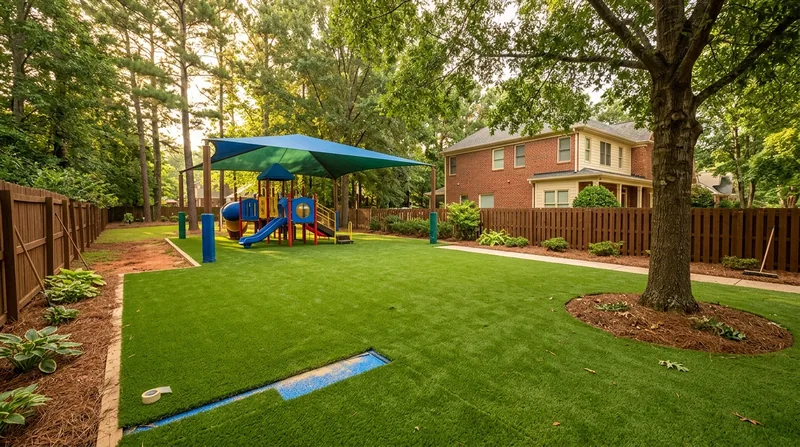




Playground and school turf in Charlotte transforms hard ground, bare patches, and maintenance-heavy grass into safe, durable play surfaces that handle the Piedmont's heat, humidity, and heavy foot traffic. Charlotte's schools and recreation departments across the city, from Concord to Matthews to Huntersville, face the same challenge: maintaining natural grass in summer heat and shade under constant use, or investing in synthetic turf that stays green, reduces injury risk, and cuts water and fertilizer costs to near zero. We install playground and school turf that meets ASTM safety standards, drains properly on clay-heavy lots, and performs through the seasonal extremes of the Carolinas. Since 2013, we've built turf fields and playgrounds for public and private schools, municipal parks, and daycare centers across the Charlotte region, specifying the face weight, pile height, and infill that match the age group and intended use.
Why Playground and School Turf Matters in Charlotte
Natural grass in Charlotte playgrounds fails for predictable reasons. Summer heat and the dense oak and pine canopy that define neighborhoods like Dilworth and Myers Park create shade where tall fescue thins out; clay soil drains slowly after the afternoon thunderstorms that roll through from June through August, leaving mud and standing water; and the constant impact of children's feet compacts soil and wears grass to bare patches within a season. Real grass also demands weekly mowing, fertilizer applications, and irrigation during dry spells, costs that compound year after year. Synthetic turf eliminates those pressures, stays green and playable in full sun and partial shade alike, and cushions falls better than worn or thin natural grass.
- We install turf that meets ASTM F1292 impact attenuation standards for fall protection on playgrounds and school athletic fields.
- Drainage is engineered into the base so water moves through the turf and away from the play surface, even on the clay-heavy lots common across east Charlotte and the Union County subdivisions.
- Infill systems are specified for the age group and activity level: antimicrobial options for elementary playgrounds, reinforced systems for high-school athletic fields.
- We handle the permitting and coordination with school facilities departments and municipal parks staff to ensure compliance with local codes and safety guidelines.
Choosing the right turf product and installation method protects children, extends the life of the field, and delivers a return on investment through reduced maintenance and downtime.
Key info: Charlotte-Mecklenburg Schools and parks departments across Concord, Gastonia, and Matthews require impact-attenuation testing and drainage certification before turf installation begins. We work with your facilities team to gather those specs and deliver a written installation plan that meets district standards. For details on local requirements, contact your school or parks department directly or call us at (980) 949-0681 to discuss your project.
For more context on how synthetic turf performs in high-traffic environments, the Synthetic Turf Council publishes guidelines on playground safety and performance standards at syntheticturfcouncil.org.
How We Install Playground and School Turf in Charlotte
Our process begins with a site inspection to measure the play area, test soil drainage, identify utilities, and confirm the fall-height and infill requirements for your age group and activity. We then prepare the base, install the turf, secure seams and edges, and add the specified infill. The result is a field or playground that drains properly, meets safety standards, and requires only occasional rinsing and grooming to stay playable for years.
- We assess the existing surface, grade, and drainage to determine whether base preparation is minimal or requires excavation and compaction on clay-heavy Piedmont soil.
- North Carolina 811 utility locates are requested before any digging so irrigation lines, low-voltage lighting, and underground utilities are marked and protected.
- We install a compacted base layer (typically 4 to 6 inches) to support the turf and ensure proper drainage away from the play surface and surrounding structures.
- Turf is laid in strips, seams are heat-welded or stitched, edges are secured with nails or adhesive, and infill is spread and groomed to specification.
- Final inspection confirms impact attenuation, drainage, and surface safety before the field opens to use.
The entire process typically takes 3 to 7 days depending on field size and base condition. We coordinate with your school or parks department to minimize disruption to the school calendar or recreation schedule.
Example: A 3,000-square-foot elementary school playground in Matthews required 6 inches of compacted base and 60 mils of impact-attenuating infill to meet fall-height requirements. We excavated and graded the site over 2 days, laid turf and infill over 2 more, and the playground reopened within a week. The school reduced mowing and maintenance costs by roughly 90 percent and eliminated mud and bare patches.
For information on residential artificial grass installation, we also serve homeowners with smaller yards and similar performance needs.
Playground and School Turf Installation Methods
| Approach | Description | Best for |
|---|---|---|
| Full-Depth Base Preparation | Excavate to 6 to 8 inches, remove old sod or clay, install compacted crushed stone or recycled asphalt base, then lay turf and infill. | New playgrounds, poor-draining clay lots, fields that see heavy rain and standing water. |
| Shallow Base Over Existing Grade | Grade the existing surface, add 2 to 4 inches of compacted base, lay turf and infill without full excavation. | Existing playgrounds with decent drainage, tight budgets, minimal site disruption required. |
| Permeable Infill System | Use engineered infill (rubber crumb, cork, or polyethylene beads) that cushions impact while allowing water to permeate and drain. | ASTM-compliant playgrounds, schools requiring fall-height certification, fields in high-rainfall areas. |
| Antimicrobial or Zeolite-Enhanced Infill | Infill treated with antimicrobial agents or natural zeolite to reduce bacteria and odor, especially in damp climates. | Daycare and elementary playgrounds, facilities in humid regions like Charlotte with high summer moisture. |
Each approach is tailored to the site's drainage, the age group using the field, and the budget. We specify the method in writing before work begins.
Playground and School Turf Cost in Charlotte: What to Expect
Playground and school turf pricing typically starts at $10 to $15 per square foot installed, depending on site preparation, base depth, and infill type. A 3,000-square-foot elementary playground runs roughly $30,000 to $45,000; a 10,000-square-foot athletic field ranges from $100,000 to $150,000. The largest cost drivers are base preparation (excavation and compaction on clay soil), infill specification (antimicrobial or impact-attenuating systems cost more than standard rubber), and site access (tight spaces or narrow gates require more labor). Schools and parks departments often budget for the project over multiple years or apply for grants to offset costs.
We always provide a free, no-obligation estimate after an on-site inspection. Our estimate includes the turf product name, face weight, pile height, infill type and pounds per square foot, base depth, and total installed cost. For more detailed pricing information and worked examples for different field sizes, visit our pricing page.
Why get a formal estimate rather than a per-square-foot quote online? Because playground turf cost depends on real factors: whether the site has existing sod or bare clay, how much excavation and grading is needed, local drainage patterns, and the specific infill and safety certifications your school or parks department requires. Two sites that look similar on paper can have very different costs once we measure and test drainage.
Playground and School Turf Near Me: What Charlotte Homeowners and Facility Managers Should Know
Hiring a turf installation company for a school or playground project is different from hiring one for a backyard. You need a team that understands ASTM safety standards, can coordinate with school facilities departments, handles permitting, and delivers a written specification covering product, base, infill, and safety testing. Here's how to vet any turf installer, including us.
- Ask for a certificate of insurance naming general liability and workers' compensation coverage, and verify it covers the scope of work on school or municipal property.
- Request a written specification that names the turf product, face weight, pile height, infill type and pounds per square foot, base depth and compaction method, and any ASTM or safety certifications.
- Check references from other schools, parks departments, or playgrounds the installer has completed in the Charlotte region and beyond.
- Confirm the installer understands local permitting requirements and will coordinate with your school or parks department on site access, utility locates, and schedule.
- Get at least two or three estimates so you can compare scope, materials, and price before committing.
We are fully insured and have installed turf for schools and parks across Charlotte, Concord, Gastonia, Matthews, Huntersville, and beyond. Every project includes a written spec and coordination with your facilities team. Call us at (980) 949-0681 or request a free estimate to discuss your playground or school field project. Response within 24 hours, no obligation to book.
Playground & School Turf in Charlotte: Pricing Guide
| Service | Price | Details |
|---|---|---|
| Elementary playground (2,000-4,000 sq ft) | Starting at $10/sq ft | Includes standard base prep, impact-attenuating infill, seam welding, and edge securing for safety compliance |
| Athletic field or large playground (5,000-15,000 sq ft) | Starting at $12/sq ft | Full-depth base preparation, compacted stone or recycled asphalt, engineered drainage, and antimicrobial or performance infill |
| Site with heavy excavation or poor drainage | On estimate | Clay-heavy Piedmont soil or existing standing water requires test and custom base design before pricing is firm |
| ASTM F1292 impact-attenuation testing and certification | Additional $1,500-$3,000 | Third-party lab testing to certify fall protection and impact attenuation for regulatory compliance if required by school or municipality |
| Travel and site inspection | Included | No separate mileage fee or call-out charge in Charlotte and surrounding areas including Concord, Matthews, Gastonia, and Huntersville |
| Free estimate | No charge | On-site inspection, written spec with product details, and pricing estimate within 24 hours, no obligation to proceed |
Indicative pricing, the exact cost depends on square footage, finish, and site access. Free personalized estimate within 24h at (980) 949-0681.


