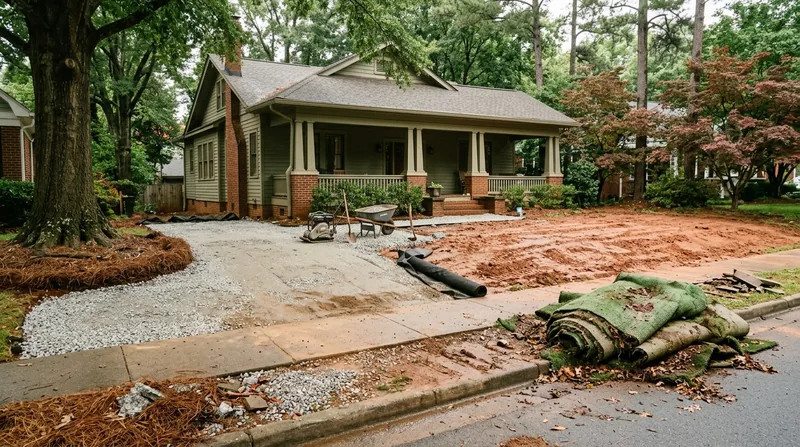




Turf Removal, Replacement & Lawn Conversion in Charlotte is a practical answer to failing lawns, drainage problems, and the heat stress that kills tall fescue and thins Bermuda under the oak canopy that covers so much of the Piedmont. Charlotte's red clay soil, summer humidity, and afternoon thunderstorms create wet winters and compacted summers where a healthy lawn becomes impossible. Whether you're converting a patchy yard to artificial turf, removing old sod before installation, or reclaiming a muddy slope, we handle the full scope of removal, site prep, and conversion work. Our approach is straightforward: we remove the old turf cleanly, address drainage if needed, prepare a stable base, and install new artificial grass that performs in full sun and deep shade alike. Since 2013, we've worked across Charlotte, Concord, Matthews, Huntersville, and the surrounding Piedmont, tackling yards with real problems and delivering solutions that last. Call us at (980) 949-0681 for a free estimate, or read on to understand how the work is done and what it costs.
Why Turf Removal and Lawn Conversion Matter in Charlotte's Climate
Charlotte's dense oak canopy, red clay, and summer heat combine to make natural lawn maintenance a losing battle for most homeowners. Tall fescue, planted in so many of the 1950s and 1960s brick ranches across east Charlotte and the 1990s subdivisions in Ballantyne and Huntersville, thins out under heat and shade by mid-July. Bermuda grass in the sunny yards turns dormant and brown in winter, and both species struggle when the soil stays waterlogged after a thunderstorm. Rather than fight the climate and terrain with repeated seeding, fertilizer, and irrigation, many homeowners choose to remove the failing lawn entirely and install artificial turf that performs year-round without the water, mowing, or seasonal die-back.
- Remove old sod and dead turf to eliminate the substrate for weeds and fungal growth.
- Grade and improve drainage so water moves away from the foundation and doesn't pool in low spots.
- Install a compacted base layer that supports artificial turf and prevents settling or soft spots.
- Convert wet, muddy yards into usable outdoor space that stays dry and firm underfoot.
- Eliminate the need for mowing, watering, and seasonal lawn treatments that don't work in Charlotte's shade and heat.
Proper removal and base preparation are the foundation of any turf installation that lasts. Cutting corners here leads to soft spots, seams that separate, and turf that moves underfoot.
Key info: Charlotte's Piedmont terrain slopes toward the Catawba River and Lake Norman, and many yards sit on the transition between high ground and clay swales. If your yard stays wet after a rain or stays muddy in winter, drainage is the real problem. We evaluate every site before removal to confirm whether grading alone or a full base build solves the issue. For guidance on what permits or HOA approvals may apply to your address, check with the City of Charlotte planning and development office or your HOA architectural committee.
How We Perform Turf Removal, Replacement & Lawn Conversion in Charlotte
Our process begins with a site walk to understand the existing turf condition, soil type, drainage, and any obstacles like tree roots, utility lines, or proximity to structures. We request a North Carolina 811 utility locate before any excavation to mark public water and power lines. Private lines, including irrigation, low-voltage lighting, and pet-fence wires, are the homeowner's responsibility to mark or locate. Once the site is clear, we remove the old turf, grade the yard to shed water, install a compacted base layer, and prepare the surface for residential artificial grass installation or another turf application.
- Inspect the existing lawn and soil condition to identify drainage issues, roots, and compaction.
- Request NC 811 locates for public utility lines and confirm private line locations with the homeowner.
- Remove old turf by sod cutter, leaving a clean subgrade ready for base prep.
- Grade and slope the yard to direct water away from structures and low spots.
- Compact the base layer to a stable, firm surface that supports artificial turf without settling.
- Install landscape fabric if needed to prevent weeds and separate the base from the infill.
- Position the new turf, seam and secure edges, and install the specified infill.
Each step builds on the last. A yard that's not properly graded or compacted will fail, no matter how good the turf is.
Local example: A 1960s brick ranch in Mint Hill with a sloped backyard that pooled water every winter. The homeowner had tried fill, regrading, and sod without success. We removed the old lawn, installed a 4-inch compacted base with proper slope, and laid down artificial turf with drainage aggregate. The yard now sheds water in minutes, stays firm year-round, and the homeowner eliminated the weekly mowing and seasonal fungal problems that plagued the natural lawn. See how we approach turf repair and seam work to keep installations solid over time.
| Approach | Description | Best for |
|---|---|---|
| Sod Cutter Removal | Use a mechanical sod cutter to remove the old turf in strips, leaving a clean subgrade and minimal disruption to the landscape. | Most residential yards where the old lawn is failing or dead and the soil is accessible. |
| Manual Removal and Grading | Hand removal combined with grading to address low spots, poor drainage, or heavy root systems that a sod cutter cannot handle. | Yards with mature tree roots, complex drainage issues, or steep slopes where equipment access is limited. |
| Base Build and Compaction | Install 3 to 4 inches of compacted aggregate base to create a firm, stable surface and improve drainage on clay or poorly draining soil. | Yards that stay wet, have poor drainage, or sit on sloped terrain where settling or soft spots are a risk. |
| Landscape Fabric and Weed Control | Lay landscape fabric over the base layer to prevent weeds from growing through and to separate the base from the infill. | Any installation where long-term weed suppression and clean separation of materials is important. |
| Hardscape Conversion | Remove turf from patios, driveways, or areas with concrete and prepare them for artificial turf with proper underlay and drainage. | Yards where a patio or driveway exists and the homeowner wants to add turf or convert the space to a usable outdoor area. |
Turf Removal, Replacement & Lawn Conversion Cost in Charlotte: What to Expect
Turf removal starts at approximately $2 per square foot, depending on the size of the yard, the condition of the existing lawn, soil type, and access for equipment. A typical residential yard of 500 to 1,000 square feet may run $1,000 to $2,000 for removal and base prep alone, before the artificial turf is installed. Larger properties, yards with heavy tree root systems, poor drainage, or steep slopes will cost more. The best way to get an accurate number is to request a free on-site estimate, where we can see the actual conditions and give you a firm price.
Several factors move the cost up or down. A small, flat, accessible yard with good drainage and no tree roots costs less to remove than a sloped, shaded, rooted lot with standing water. If grading and base build are needed to fix drainage, that adds labor and materials. If the old turf is thick or compacted, removal takes longer. Equipment access, proximity to structures, and the size of the area all affect the final bid. Visit our full pricing overview for more detail and worked examples on common yard sizes.
We recommend getting 2 to 3 estimates from different installers before you decide. Ask each one for a written breakdown of the removal cost, base prep, and any grading or drainage work. The cheapest estimate is not always the best; a low-ball price often means shortcuts on base compaction or drainage, which will cost you far more in repairs later. A professional estimate should name the depth and type of base material, the compaction method, and any drainage improvements included.
What to Look for When Hiring a Turf Installation Company Near Charlotte
Turf removal and replacement is a skilled trade, and the quality of the work directly affects how long your new lawn will last. When you are evaluating a turf installation company near me or near Charlotte, look for a few concrete markers of professionalism. First, verify that the company carries a certificate of insurance naming general liability and workers' compensation coverage. Ask to see the certificate; it's a simple way to confirm they are fully insured and that you are protected if anything goes wrong on your property. Second, ask for a written specification of the turf product, the face weight, pile height, infill type and pounds per square foot, and the base depth and compaction method. A company that won't write this down is either unsure of what they're installing or doesn't care about the details. Third, check references and ask to see photos of finished work, especially removal and base prep on yards similar to yours. A good installer will have examples of yards in Charlotte or nearby that show clean removal, proper grading, and a solid base. Fourth, confirm whether permits or HOA approvals are required for your address and ask whether the company will help with submittals or coordinate with your HOA. Finally, call us at (980) 949-0681 or visit our contact page to request a free estimate and references from recent jobs in your neighborhood.
- Request a certificate of insurance showing general liability and workers' compensation coverage.
- Ask for a written specification that names the turf product, face weight, pile height, infill type, base depth, and compaction method.
- Check references and ask to see photos of removal and base prep work on similar Charlotte yards.
- Confirm whether your address is subject to HOA architectural rules or city permits, and ask how the company handles approvals.
- Get 2 to 3 estimates and compare the scope of work, not just the price.
- Verify that the company is local and has a physical address in the Charlotte area, not an out-of-state or transient crew.
A professional turf installer takes time to understand your yard, writes down the details, and stands behind the work with references and photos. If you feel rushed, pressured to decide, or unsure what you're paying for, keep looking.
Turf Removal, Replacement & Lawn Conversion in Charlotte: Pricing Guide
| Service | Price | Details |
|---|---|---|
| Sod Removal (Standard) | Starting at $2.00/sq ft | Mechanical sod cutter removal on accessible, relatively flat yards with minimal tree root interference and good equipment access |
| Removal Plus Base Prep | Starting at $3.50/sq ft | Includes removal, grading, and 3 to 4 inches of compacted aggregate base to improve drainage and create a firm surface |
| Complex or Rooted Removal | On estimate | Manual removal, extensive grading, drainage solutions, or yards with heavy tree roots, steep slopes, or poor access require site assessment |
| Hardscape Conversion | On estimate | Removal of turf from concrete patios or driveways and preparation for artificial turf with proper underlay varies by area and existing conditions |
| Travel | Included | No separate charge for service calls within Charlotte and surrounding areas including Concord, Gastonia, Matthews, Huntersville, and Mint Hill |
| Free Estimate | Free | On-site consultation and written estimate with no obligation to book, response within 24 hours at (980) 949-0681 |
Indicative pricing, the exact cost depends on square footage, finish, and site access. Free personalized estimate within 24h at (980) 949-0681.


